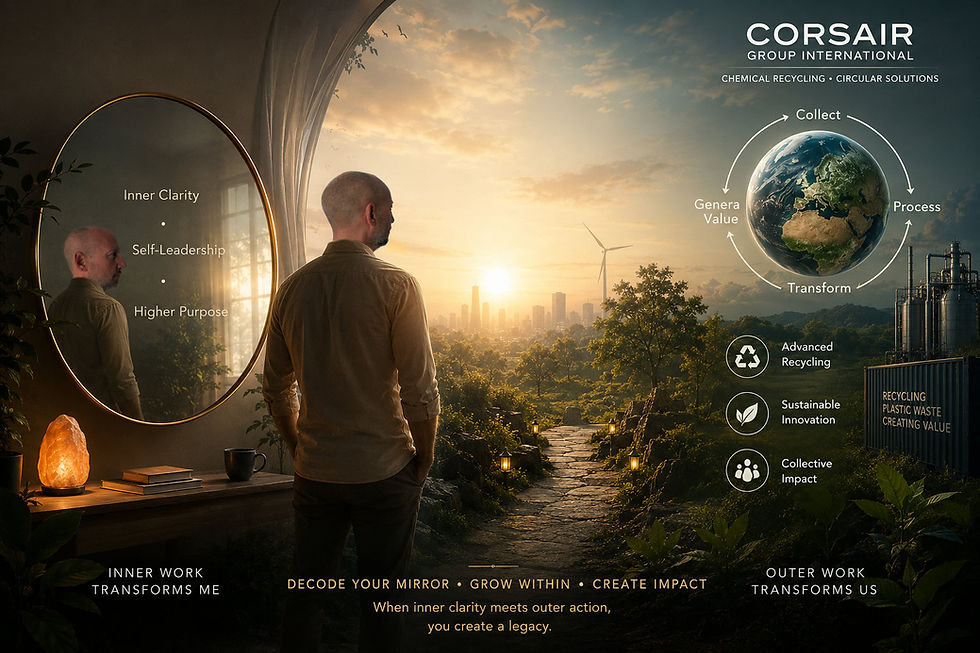
Lead Your Business Toward Plastic Neutral Leadership

Consumers and customers are increasingly aware of the environmental impact of business. Sustainability now drives growth, trust, and lasting impact. Your business can turn plastic waste into opportunity, attract customers who value responsibility, and create measurable change for communities and oceans.

This guide shows how to take bold action, implement practical solutions, and position your brand as a leader in plastic neutral innovation.
Learn more about Corsair an how you can Lead Your Business Toward Plastic Neutral Leadership:
Masterclass Episode 1 : Introducing Corsair Group
Turning Global Crisis into Circular Opportunity
In 2020, amid lockdowns and global uncertainty, five founders gave life to Corsair Group. A vision born from challenge. While the oil market collapsed and many turned away, they stepped forward with conviction that every great challenge hides an even greater opportunity.
From that moment, Corsair grew into a network of over 30 companies across continents, employing more than 100 dedicated professionals. With headquarters in the Netherlands and offices in Finland and Thailand, the group embodies collaboration without borders.
Corsair’s purpose is clear: to transform the global plastic waste crisis into a cycle of value. By combining innovation, technology, and sustainable design, the company develops long-term systems that regenerate instead of deplete.
Where others saw decline, Corsair saw renewal.
Where waste once ruled, circular intelligence now leads by example.
Masterclass Episode 2 : The Global Plastic Waste Crisis
The Scale of Plastic Waste and the Call for Global Action
Every year, humanity now produces close to 500 million metric tons of plastic. To put that into perspective: the combined weight of all humans on Earth is around 350 million metric tons. In a single year, we create more plastic than the total mass of our species.
Yet 95% of that plastic is never recycled. Only a fraction,barely 5%, finds its way back into use. The rest ends up buried, burned, or drifting into the oceans that sustain life itself.
With global production set to triple within the next 30 years, the challenge intensifies.
Economic growth across Asia, Africa, the Middle East, and Latin America brings prosperity and with it, greater demand for packaged goods. Every new supermarket shelf lined with plastic adds to a system already overflowing.
This is the pulse of our present reality. Unless we rapidly expand a worldwide recycling infrastructure, the recycling rate will fall even further as production rises.
The choice is clear.
Either we innovate now and create circular systems that regenerate materials or we watch this world drown in its own excess.
Action begins where awareness turns into responsibility.
Every piece of plastic carries the potential for renewal.
Masterclass Episode 3 : Corsair's Solution To Plastic Pollution
Plastic Returns to Its Original Power
At Corsair Group, every piece of plastic waste regains value. From bags and packaging to wrappings and containers, everything once discarded transforms back into its pure liquid form; oil.
All plastic once began as crude oil.
Through the advanced recycling process called pyrolysis, Corsair restores plastic to its molecular essence. The structure is gently opened and rebuilt into pyrolysis oil.
This oil can be refined into diesel, gasoline, or jet fuel, and also reused for producing new plastics. The cycle completes itself. From 1,000 kilos of plastic waste, up to 900 liters of oil emerge, energy renewed through precision and purpose.
Corsair holds the ISCC certification: www.iscc-system.org
You can click this link and type CORSAIR in the search bar to get the details https://www.iscc-system.org/certification/certificate-database/all-certificates ISCC is the highest international standard for sustainability and carbon balance, and fully complies with European environmental requirements.
With licensed facilities in Thailand and Finland, Corsair operates with clarity, integrity, and care for the planet.
Each drop of oil reflects renewal, restoration, and conscious innovation.
Corsair transforms waste into worth, and plastic into purpose.
Masterclass Episode 4 : Pyrolysis Oil
Turning Plastic Waste into the Gold of the Future
The pyrolysis oil created by Corsair is recognized by leaders in the petrochemical industry as the highest quality available today. This excellence is the result of over two years of dedicated development, refining every detail to transform plastic waste into a product of lasting value.
The oil produced from discarded plastic can be refined into gasoline, diesel, or jet fuel, and holds even greater promise as a foundation for new plastic materials.
Since early 2023, Corsair has been in close collaboration with Shell, now the company’s primary offtaker, working together to advance cleaner and more circular solutions for the future of plastic production.
Through this process, old plastics become new resources. A single plastic bag, once pollution, is transformed by Corsair into oil, and that oil is reborn as a new, sustainable product. This closes the loop, turning waste into renewed material that supports a greener and cleaner planet.
Regulations worldwide now call for this transformation. The industry is shifting toward circular production, where every product carries the potential for return. Just as we recycle paper, glass, and metal, plastic will soon follow the same path.
This journey takes time and cooperation. Yet with growing awareness, advanced recycling, and shared purpose, plastic waste will evolve into a traded commodity,
Plastic waste can now be valued like rice, metal, or gold.
Corsair envisions a world where mountains of garbage become mountains of value—where what once polluted now powers regeneration.
Masterclass Episode 5: The Pyrolysis Process
From Waste to Resource with the Power of Pyrolysis
The word pyrolysis originates from Latin roots: pyrol meaning heat and lucis meaning separation.
It describes a process where heat transforms plastic into its most fundamental molecular elements without burning it.
Inside the reactor, plastic never touches the flame. It’s gently heated in what engineers call “the world’s largest pizza ovens.” As the material spins and melts, it releases flammable gases that fuel the system itself. Once the cycle begins, the process becomes energy self-sustaining, needing only minimal electricity to keep the motors turning.
Through condensation, the released vapors transform into pyrolysis oil, a liquid that can serve as a renewable alternative to diesel or gasoline. Each reactor can process up to nine tons of plastic per batch, turning what was once waste into usable energy.
By combining technology, circular thinking, and the precision of clean preparation, Corsair Group International demonstrate that sustainability is not a dream. Pyrolysis is a process where plastic regains purpose and energy flows in a closed, intelligent loop.
Plastic returns to purpose. Energy returns to life.
Masterclass Episode 6: Inside Corsair's Sa Kaeo 'Waste Management Facility'
From Waste to Worth The Daily Cycle of Transformation at Corsair
Each day at Corsair, a powerful process unfolds, turning decades of plastic waste into a valuable source of new energy.
The journey begins with raw material recovery from a Thai government-owned landfill in Sakeo, where more than 50 million kilos of mixed waste have accumulated over the past 30 years.
Corsair’s teams carefully extract old plastic waste from the site while also receiving new daily waste from the surrounding community. Since waste separation at the source is rare in Southeast Asia, everything, plastic, metal, paper, and organic matter arrives mixed.
Through a combination of mechanical and manual sorting, Corsair separates the plastics, while other materials such as metal, glass, and paper are directed to specialized recyclers. The selected plastics are then washed, dried, and prepared for transformation, ensuring the purity needed to create the highest quality pyrolysis oil.
Once ready, the plastic is baled and loaded into Corsair’s reactors, each capable of holding up to 9,000 kilos per cycle.
Over a 20 to 24-hour process, the material is carefully heated and converted into liquid oil, yielding up to 900 liters per 1,000 kilos of clean plastic.
Every step of this process reflects precision, care, and a deep commitment to regeneration. Through this daily rhythm, Corsair turns forgotten waste into valuable energy.
Corsair embodies a living example of circular progress in motion.
Masterclass Episode 7: The Next Step : How Corsair Pyrolysis Oil is Used
From Plastic to Pure Pyrolysis Oil
Once pyrolysis oil emerges from the reactor at Corsair, it begins a careful refinement process. The oil is first placed in a standing container for approximately 24 hours, allowing any remaining water formed from moisture in the plastic to naturally separate. This step ensures the purity and quality of the final product.
The preparation of raw plastic plays a crucial role. Clean and dry plastic produces maximum yield. If the material contains moisture, such as rain-soaked plastic, the first hours in the reactor release steam instead of oil. The standing container resolves this naturally, separating water for further treatment in a dedicated water cleaning system.
After separation, the oil is filtered, stored, and prepared for delivery.
Shipments are loaded into ISO chemical containers, each capable of holding up to 24,000 liters, ready for transport to clients. Partners like Shell utilize this oil in their chemical processes,
contributing to the creation of new plastic products.
This daily cycle embodies the power of pyrolysis, transforming plastic waste into high-quality oil that regenerates the material cycle and supports a cleaner, circular future.
Plastic is transformed. Oil is regenerated. Circular value is created.
Masterclass Episode 8: Which Types Of Plastic Can Corsair Recycle?
We are Recycling Every Plastic That Matters
At Corsair, we work with a wide range of plastics, focusing on the materials most overlooked by traditional recycling systems. While we can technically process almost all plastics except PVC, our main expertise lies in polyolefin plastics: the films, bags, and wrapping materials that form the bulk of everyday plastic waste.
PET plastics, such as bottles, are largely handled by well-established mechanical recycling systems. These systems break the bottles into pellets for construction and industrial use.
Corsair focuses instead on the plastics that are often ignored: colored plastics, multi-layered materials, and complex composites. These have traditionally been labeled unrecyclable, yet through advanced chemical recycling techniques, we are able to transform them into valuable resources.
Our approach is simple but powerful: we take the plastics nobody else wants.
By addressing these challenging materials, we reduce environmental impact, recover resources, and expand the possibilities of circular recycling. Corsair continues to innovate, developing solutions to process plastics from landfills and communities, always striving to be the most efficient and sustainable recycler possible.
Where others see waste, Corsair sees opportunity.
Every plastic has potential.
Masterclass Episode 9: Plastic Waste Doesn't Belong In Landfills
Transforming Landfill Plastic into Value
Plastic waste creates immense challenges for landfills. Unlike organic materials such as food, fabric, or paper that naturally decompose, plastics remain for centuries, breaking down only into microplastics that infiltrate soil and waterways, impacting health and the environment.
At Corsair, we collaborate with private and governmental landfill operators to remove decades of accumulated plastic waste while managing incoming waste streams. By separating plastics from mixed waste, we ensure only biodegradable materials enter landfills while plastics are directed to recycling operations.
In Thailand alone, over 2,000 landfills generate around 3 billion kilos of plastic waste annually. While plastic represents only 20–25% of the landfill weight, its volume occupies significant space, making efficient management essential.
Many landfills are already full or nearing capacity.
Through chemical recycling, Corsair transforms this old and new plastic into high-quality pyrolysis oil, creating value from what once burdened landfills.
By building effective recycling infrastructure, we reduce environmental impact, reclaim resources, and turn persistent waste into a sustainable and valuable raw material.
Plastic waste becomes energy, landfills regain space, and the planet moves toward circular regeneration.
Masterclass Episode 10: Beyond Landfills : Other Sources Of Plastic Waste
Plastic Waste Collection and Recycling Initiatives
Why this matters? Plastic waste threatens oceans, communities, and the environment. By creating structured collection programs, we prevent plastic from mixing with organic waste, increase recycling efficiency, and provide financial opportunities for communities. Each action contributes to cleaner cities, healthier ecosystems, and sustainable livelihoods.
What is possible?
Corsair has developed a plastic waste collection network with over 150 collection points across Bangkok. Hospitals, shopping centers, hotels, apartments, restaurants, and car dealerships now provide bins for staff, tenants, and customers to separate plastic at the source. This isolation of plastic streamlines recycling and prevents contamination with food waste or dirt.
Collaborations with other waste management companies further enhance efficiency by separating plastics for chemical recycling processes. The innovative Catching Plastic program engages over 100,000 Thai fishermen to collect plastic from the ocean. Fishermen receive payment for each kilo collected, creating dual income streams from fishing and plastic recovery.
Trash for Cash centers, launched in collaboration with the Bangkok Community Health Foundation, enable residents of the largest slum in Thailand to earn money for every kilo of plastic they bring in. Over 140,000 residents now generate income while cleaning their communities. These programs scale social and environmental impact, turning waste into value.
How Corsair works:
Corsair installs collection bins, partners with local organizations, and coordinates with waste management companies. Chemical recycling and community-based programs integrate income generation with environmental responsibility. Every initiative provides measurable impact on local livelihoods, urban cleanliness, and ocean health.
Who benefits?
Local communities, urban residents, small businesses, fishermen, and environmental stakeholders all gain. Low-income populations access financial support while improving their surroundings. Businesses enhance sustainability practices. Ecosystems benefit from reduced plastic pollution.
The only certainty is change. The greater the change, the greater the opportunity.
Are you ready to Lead Your Business Toward Plastic Neutral Leadership?
How can you Build Plastic Neutral Leadership for Your Business?
Seize the Business Opportunity and Go Plastic Neutral
1️⃣ Calculate Your Plastic Footprint to know your impact.
2️⃣ Remove Plastic • Corsair collects and recycles in your name.
3️⃣ Get Verified & Show Impact Receive a plastic neutral certificate and marketing support to showcase your sustainability.
Join this movement as an individual, brand, or company. Turn plastic waste into value, empower communities, protect oceans, and make a measurable environmental impact.
My name is Dennis Schoofs,
Corsair Group Senior Executive Coordinator from Belgium. If you are a business owner ready to make your company or products plastic neutral, this 15 minute session will explore practical strategies, opportunities, and steps to achieve your sustainability goals. Are you ready to Lead Your Business Toward Plastic Neutral Leadership?
Gain clarity, actionable guidance, and a concrete plan to enhance your environmental impact while attracting customers who value your responsibility.
Book your discovery call today and take the first step toward making your brand plastic neutral.