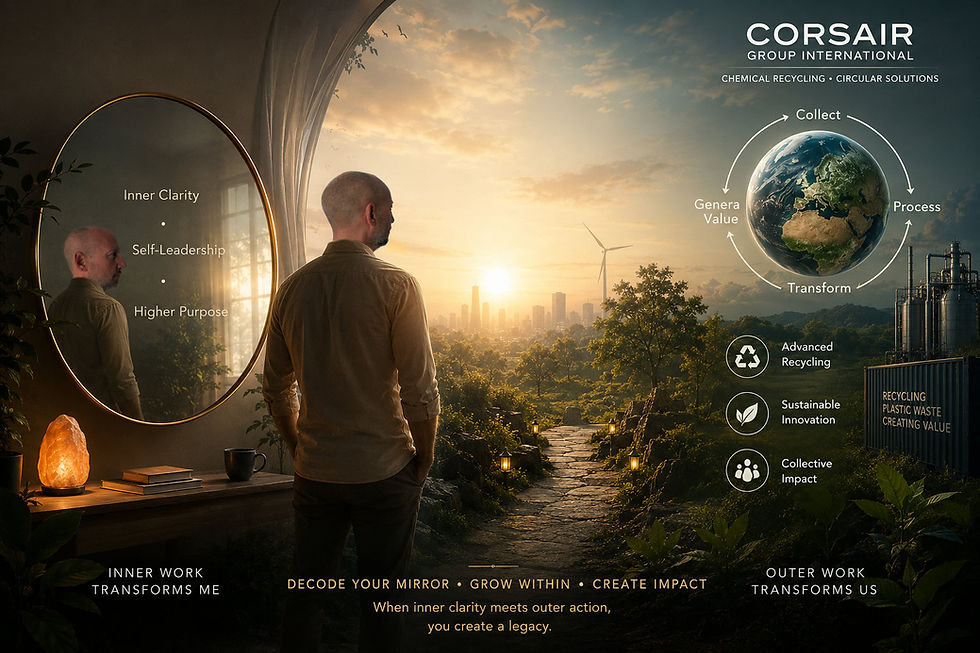
Belgium can no longer export or burn away our plastic waste problem

For decades, the solution to plastic waste has largely been:
collect it → sort what we can → recycle some → burn the rest → export what we cannot handle.
That model is reaching a turning point.
Starting from 21 November 2026, the EU will prohibit exports of plastic waste to non OECD countries.
What are we going to do with the plastic we can no longer export?
♻️ PLASTIC WASTE BELGIUM :
THE 2025 FACTS & NUMBERS
Belgium is already reporting major progress.
• Every Belgian collected an average of 26.1 kg of PMD packaging.
• Almost three quarters of plastic packaging placed on the Belgian market by Fost Plus members was recycled.
• More than half of collected plastics are now recycled in Belgium.
• Domestic plastic packaging recycling increased almost sixfold in four years.
So wow, that sounds like the problem is being solved. But It isn't. Because the real question is:
Plastic Waste... RECYCLED INTO WHAT?
And what happens to the plastic that cannot be mechanically recycled?
Today, one of Belgium's major waste management routes is incineration with energy recovery.
Burning waste and recovering energy is allowed under current EU legislation.
But there is a fundamental problem with calling this a long term circular solution:
🔥 When you burn plastic, you recover energy. ♻️ When you recycle plastic, you recover material.
Those are fundamentally different outcomes.

The EU Waste Hierarchy already places recycling above energy recovery.
And Europe's regulatory direction is becoming increasingly clear.
The new Packaging and Packaging Waste Regulation is pushing Europe toward packaging that is designed to be recyclable, contain recycled content and remain within a circular material system.
The EU's objective is increasingly:
🚫: BURN THE MATERIAL.
✅ : KEEP THE MATERIAL.
So Belgium now faces a strategic question.
IS TODAY'S SOLUTION FORM BELGIUM FIT FOR TOMORROW'S REGULATIONS?
Belgium has invested heavily in incineration infrastructure.
That infrastructure was designed around a world where residual waste could be burned, energy could be recovered, and waste that could not be handled locally could be moved elsewhere.
But Europe is moving toward:
♻️ Less waste generation
♻️ More reuse
♻️ Higher quality mechanical recycling
🌍 Keeping valuable materials within Europe
🔄 Increasing recycled content in new products
🔬 Advanced recycling for suitable plastic streams that mechanical recycling cannot efficiently process
The contradiction becomes obvious:
An incinerator needs material to disappear.
A circular economy wants to keep materials in circulation.
This does not mean Belgium's incinerators will suddenly close tomorrow.
It means something more important:
The infrastructure that was built for yesterday's waste model may increasingly become incompatible with tomorrow's circular economy.
So the Belgium mindset for a long term plastic waste solution should therefore being changed from "How much plastic can we burn?" into "How much plastic can we recover as a valuable raw material?"
Because when Europe increasingly restricts exports, raises recycling requirements and demands more circularity, Belgium will need new processing capacity and new technologies.
The future cannot simply be: export it → burn it → forget it.
The future needs to be:
recover it → recycle it → transform it → keep its value in the European economy.
Belgium can no longer export or burn away our plastic waste problem
🇧🇪 Sooner, later or even too late, Belgium will have to deal with its plastic waste challenge.
But now, Belgium also has a major opportunity.
To build the infrastructure today that Europe will need tomorrow.
A long term solution already exists. A solution capable of transforming suitable plastic waste into valuable raw materials instead of simply burning away its material value.
The technology is here.
Belgium can no longer export or burn away our plastic waste problem
But whether today or tomorrow, the need is growing. And time is the enemy.
Those with the solution cannot be everywhere, all at once, at the same time.
So those who act now have the strongest chance to position themselves as leaders in the advanced recycling industry. And those who wait until the problem becomes impossible to ignore may find themselves on a waiting list, due to partnerships, capacity and opportunities that others secured years earlier.
Are you willing to look beyond today's waste solutions and discover what is already possible?
Take the time to learn more.
What we build today can become part of the legacy we leave for future generations.
Leading the transition to a sustainable future trough plastic waste recycling.
Dennis Schoofs Coordinator & Introducing Broker Corsair Group International
#Belgium #PlasticWaste #CircularEconomy #Recycling #AdvancedRecycling #ChemicalRecycling #Pyrolysis #WasteManagement #EU #Sustainability #CircularBusiness #PlasticRecycling